

Thresholds: our new exhibition at HEK Basel
- by Joanie Lemercier
- in blog
- posted September 21, 2026
Which boundaries do we draw and which do we cross?
How do our technological choices shape the world we live in?
And what values guide us in the face of ecological crises and profound social change?
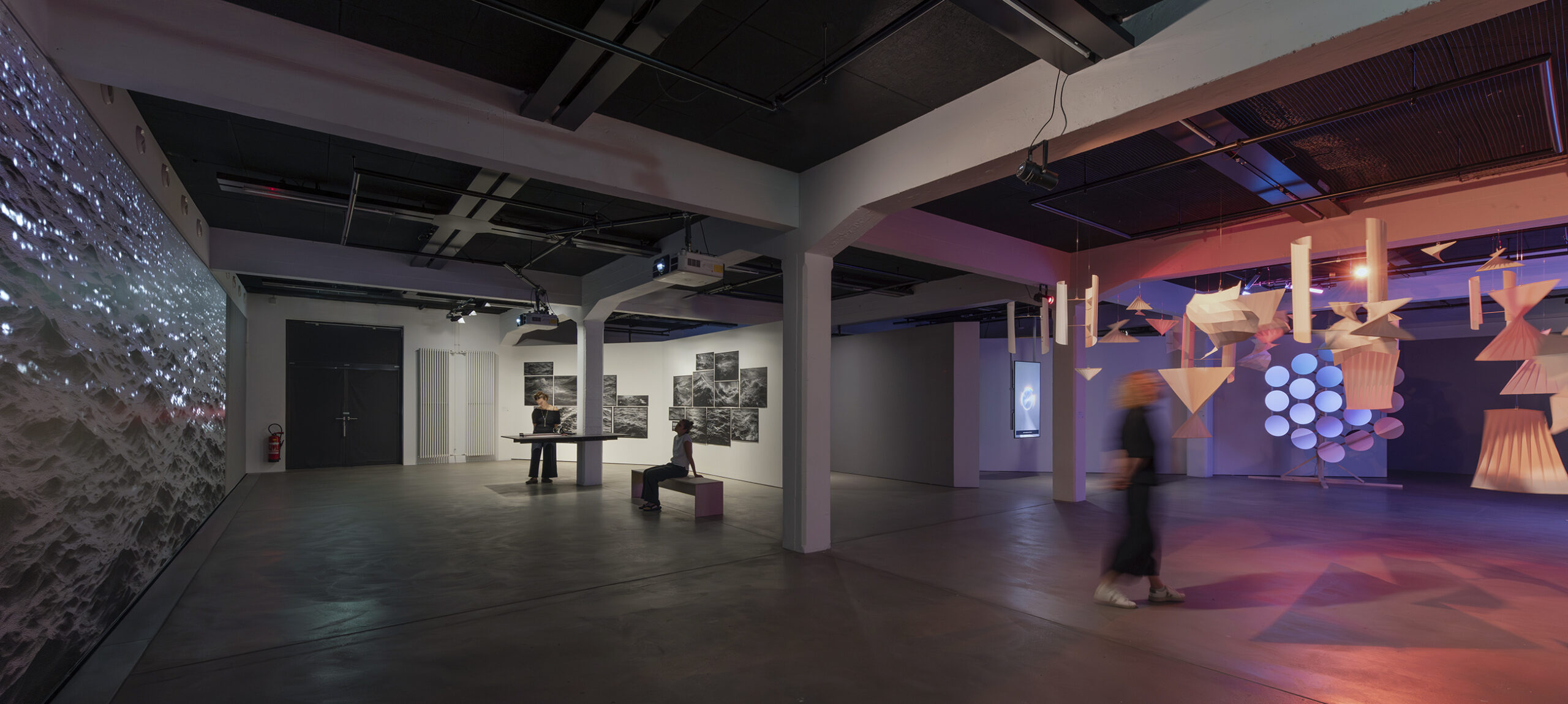
Thresholds – On the values we set and the limits we cross brings together works that explore transitions: from technology to nature, the visible and the invisible, imagination and responsibility.
Artworks: Studio Lemercier (Joanie Lemercier and Juliette Bibasse)
Curators: Juliette Bibasse and Sabine Himmelsbach
Edges
Projection surface, video projector, computer, 2020 – 2026.
Description


Data aesthetics: Infrastructure
Dual Projection (wall / transparent layer), 2026


Data aesthetics: extraction
Screen based artworks, 2026


Océans possibles
Plotter drawings, 2025


Un sentiment océanique
Dual Projection on wall paper, 2026
Un Sentiment Océanique combines a printed wallpaper with a layer of mapped video projection. An infinite panorama of the ocean is composed of hundreds of thousands of dots, generated from photographs and code. In March 2026, Joanie Lemercier and Juliette Bibasse spent two weeks crossing the Atlantic aboard a prototype sailing cargo ship. With little else to observe but the ocean, they became attentive to its almost imperceptible variations: changes in light,the movement of the water, the shifting horizon. At specific moments, almost every day, the surface of the ocean seemed to hold all the stars of the sky, as if the cosmos itself had fallen into the water. These elusive phenomena appeared and disappeared within minutes, impossible to capture. The work takes its title from Romain Rolland’s concept of the “oceanic feeling”, formulated in 1927: a sensation of the eternal and of something without perceptible limits, where the boundary between the self and the world seems to dissolve. Rooted in Spinoza’s understanding of nature as an interconnected whole, this is a spiritual experience: a sense of belonging to something greater, while remaining fully within the world.
Unlike the Sublime, which can confront us with an overwhelming force, an “oceanic feeling“ is quiet and intimate. In a time increasingly governed by measurement and rationalization, Un Sentiment Océanique proposes a different mode of attention:silence, slowness, and openness to subtle beauty.The work brings awareness to one of these fleeting encounters with the infinite.
For a few minutes, light, water and horizon become almost indistinguishable, dissolving the boundaries between the observer and what is observed. It invites a conversion of the gaze: to look differently and remain attentive to what might otherwise go unnoticed.


The color machine
Wood, mirrors, motors, custom electronics, 2026
The Color Machine is a motorized sculpture developed from the Solar Concentrator, originally designed to collect and redirect sunlight. The same structure of 19 mirrors is here combined with multiple colored light sources, transforming it into a machine for color. The work pays tribute to the Do-Nothing Machine by Charles and Ray Eames, a playful kinetic device designed to move without serving any practical purpose. Simple and inexpensive to build,Color Machine embraces a similar principle: a machine set in motion simply to create an experience, rather than to produce anything. Its motors slowly shift the mirrors from one position to another, transforming the reflections and colors across the space around the viewer. Coming to life, the machine continuously alters what the viewer sees.The work explores the porous boundary between the observer and their surroundings. As the mirrors fragment and recombine the space in constantly changing reflections, the viewer is revealed within the very images they are looking at.
The Color Machine demonstrates that the environment is not a backdrop separate from us, but something we are always embedded within, questioning the culturally built separation between humans and nature.


Wind pavilion, étude
Paper, wood, 3d prints, light. 2026
Solar Lab (Juliette Bibasse,Joanie Lemercier & Martin Pirson)
Wind pavilion, étude is a kinetic installation composed of dozens of lightweight paper windmills. The different forms and sizes are designed in 3D, then unfolded into flat templates, laser-cut from sheets of paper, and assembled by hand.
Part of the Solar Lab, the work acts as a study for a larger outdoor installation in which an accumulation of windmills would respond to air currents. Here, the small-scale models explore how movement can reveal the invisible: as the windmills turn, the air triggers a choreography, transforming imperceptible currents into a visual ballet.
Simple and inexpensive to produce, the work reflects the Solar Lab’s approach to combining technology, minimal means and natural forces to create alternative imaginaries.


Projection, 2019
Recent Comments